ZOTOVICH VINEYARD IN STA. RITA HILLS
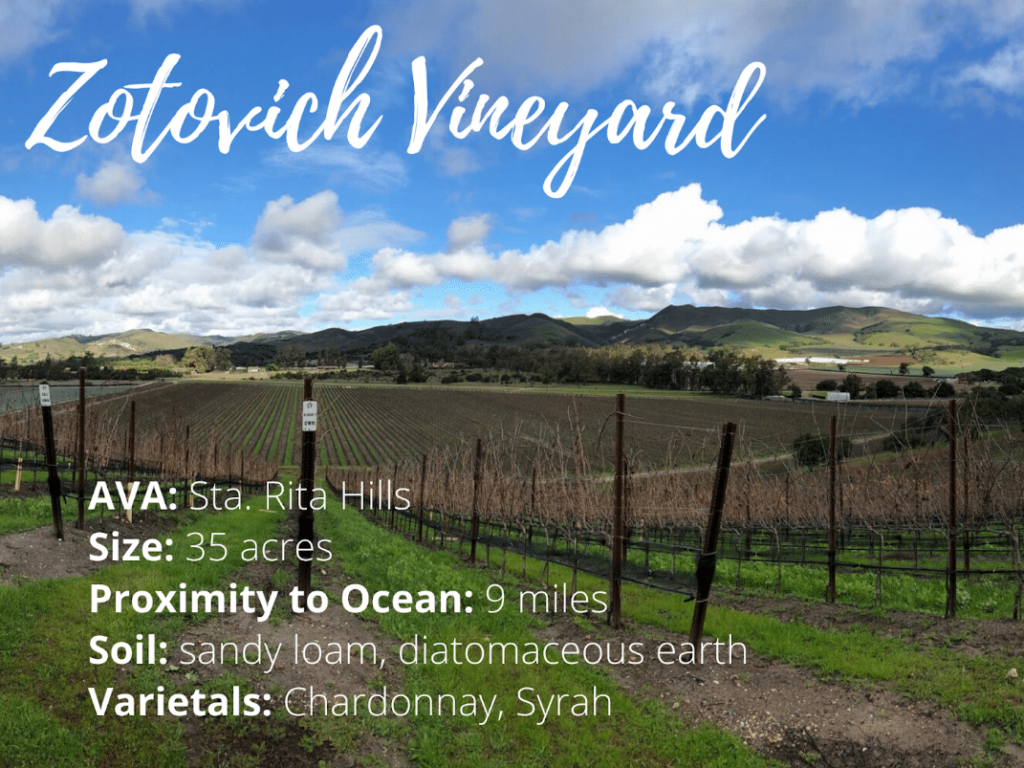
There is a moment in every glass of wine made from this place, when you taste something that doesn’t quite have a name. It isn’t fruit, exactly. It isn’t acid, though the acidity is alive and bright. It is something older than either of those things: a salinity, a mineral brine, like sea air carried inland and somehow pressed into the grape. That quality is Zotovich. And once you know it, you recognize it every time.
A Vineyard Reborn ...
Zotovich Vineyard was first planted in 1996, though not to the varieties it is known for today. The original owners established it in Italian varietals, a mismatch for soils and a climate that were quietly waiting for a different assignment. That reassignment came in 2004, when Steve Zotovich, a wine collector who understood great wine from the other side of the bottle, purchased the property. The timing was, by some accounts, inspired: he signed the deed on the very day “Sideways” was released in theaters, a film that would soon send the wine world rushing toward Santa Barbara County. Whether or not the timing was intentional, the instinct was sound.
Steve moved quickly. The entire 40-acre property was grafted over to Pinot Noir, Chardonnay, Syrah, and Viognier, varieties that fit both the soils and the climate, and Syrah and Grenache blocks were added in 2012. What had been a vineyard searching for its identity became, under deliberate and patient stewardship, one of the most sought-after fruit sources in the appellation.
A Place Unlike It's Neighbors
The Sta. Rita Hills is defined by its geography: an east-west transverse valley that acts as a funnel for cool, fog-laden air rolling in off the Pacific. Nearly every vineyard in the appellation benefits from this. What makes Zotovich different is a more intimate geological accident.
The 35-acre parcel SAMsARA sources from sits at the northern edge of the appellation, at the base of a rugged hillside just south of Highway 246. Here, the east-west ridge line kinks southward directly adjacent to the vineyard, creating a topographic channel that pulls in extra ocean air and makes Zotovich one of the most consistently wind-swept sites in the entire region. Longer hang times, slower ripening, naturally restrained sugar levels, and preserved acidity are the result.
Below the vines, the soils tell an equally distinctive story. The dominant material is diatomaceous earth and sandy loam, specifically a type of oceanic sand classified as Arnold Series sand, formed from ancient marine sediment. In the lower blocks, the ground is almost entirely sand, with few rocks of any size. Climb higher onto the hillside blocks and the profile shifts: light clay topsoil gives way to sandstone and chert. The sedimentary character of the entire property (the sand, the silica-rich diatomite, the marine rock) points toward a time when this land sat beneath the sea. The ocean has retreated, but its memory persists in the wines. The drainage these soils provide is exceptional, limiting the vine’s access to water and nutrients, and pushing its energy away from the canopy and into the fruit. Small berries. Concentrated flavor. A structure built from the ground up.
The result is a salinity in the finished wines that observers consistently describe as more pronounced here than anywhere else in the Santa Rita Hills. It is not imagined. It is geological.
Two Varieties, One Vision
SAMsARA makes two wines from Zotovich: a Chardonnay and a Syrah. This is, on the surface, an unusual pairing for a single cool-climate site. Chardonnay thrives in cold, wind-swept conditions with mineral soils; that much is expected. Syrah, in the wrong hands and the wrong place, can be a different matter — a variety that demands warmth to find its depth, that can tip easily into either jammy excess or harsh austerity when pushed too far by cold. Very few vineyards anywhere in the world ripen both successfully, and fewer still do so with the kind of consistency that earns critical attention across multiple vintages.
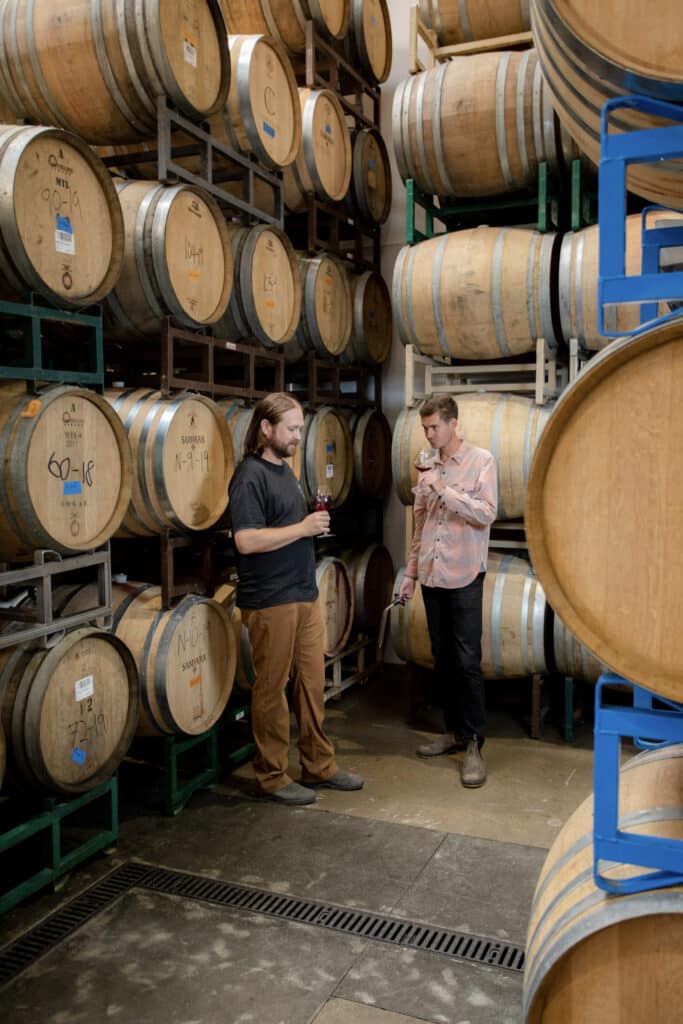
Zotovich does. The same soils and cool climate that give the Chardonnay its taut, mineral-driven focus give the Syrah its bright acidity and relatively low sugar levels, producing a Northern Rhône-inspired wine with elegance and structure rather than weight. The thread connecting the two is subtlety: neither wine shouts. Both give generously on the palate — the Syrah with dark fruit and savory complexity, the Chardonnay with breadth and crystalline mineral character — but neither overwhelms. Winemaker Matt Brady, who intervenes as little as possible in the cellar, allows the vineyard to speak clearly. Whole cluster fermentation for the Syrah. Native yeast for the both. The winemaking decisions are deliberate acts of restraint, made in service of the place.
What the Critics Say
Across more than a decade of vintages, the vocabulary critics reach for when describing these wines is strikingly consistent. Saline. Mineral. Focused. Translucent. Elegant.
Antonio Galloni of Vinous awarded 94 points to the 2021 Chardonnay and described it as “vibrant, intensely saline” and “wonderfully translucent.”
Wine Enthusiast matched the score and found a wine of “rocky minerality,” citrus spray, and tight apple flesh.
The 2021 Syrah drew SAMsARA’s own note that it is “always a knockout,” built for a decade of aging with a deep core of fruit that will only open further with time.
Wine & Spirits called the 2020 Syrah “exotic right out of the gate,” with “splendid energy and impressive length.”
Consistency across vintages is the mark of a great site, not a lucky year. The scores and descriptions here span 2014 through 2021. The vocabulary barely changes.
Zotovich does. The same soils and cool climate that give the Chardonnay its taut, mineral-driven focus give the Syrah its bright acidity and relatively low sugar levels, producing a Northern Rhône-inspired wine with elegance and structure rather than weight. The thread connecting the two is subtlety: neither wine shouts. Both give generously on the palate, the Syrah with dark fruit and savory complexity, the Chardonnay with breadth and crystalline mineral character, but neither overwhelms. Winemaker Matt Brady, who intervenes as little as possible in the cellar, allows the vineyard to speak clearly. Whole cluster fermentation for the Syrah. Native yeast for the both. The winemaking decisions are deliberate acts of restraint, made in service of the place.
Why It Matters
The Sta. Rita Hills is a young appellation (AVA status arrived only in 2001) but its best vineyards are already demonstrating the kind of site-specific identity that takes generations to establish in older wine regions. Zotovich is among a small handful that has distinguished itself not just within the appellation but in relation to California’s broader cool-climate conversation. Its oceanic soils, its topographic wind channel, its uncanny ability to produce two entirely different grape varieties with equal distinction. These are not marketing claims. They are verifiable in the glass, vintage after vintage.
SAMsARA has sourced from Zotovich long enough to know it deeply, and the wines reflect that relationship: not just technically accomplished, but expressive of a place that has something genuinely singular to say.