No products in the cart.
2026 Harvest Update: An Early and Unusual Vintage
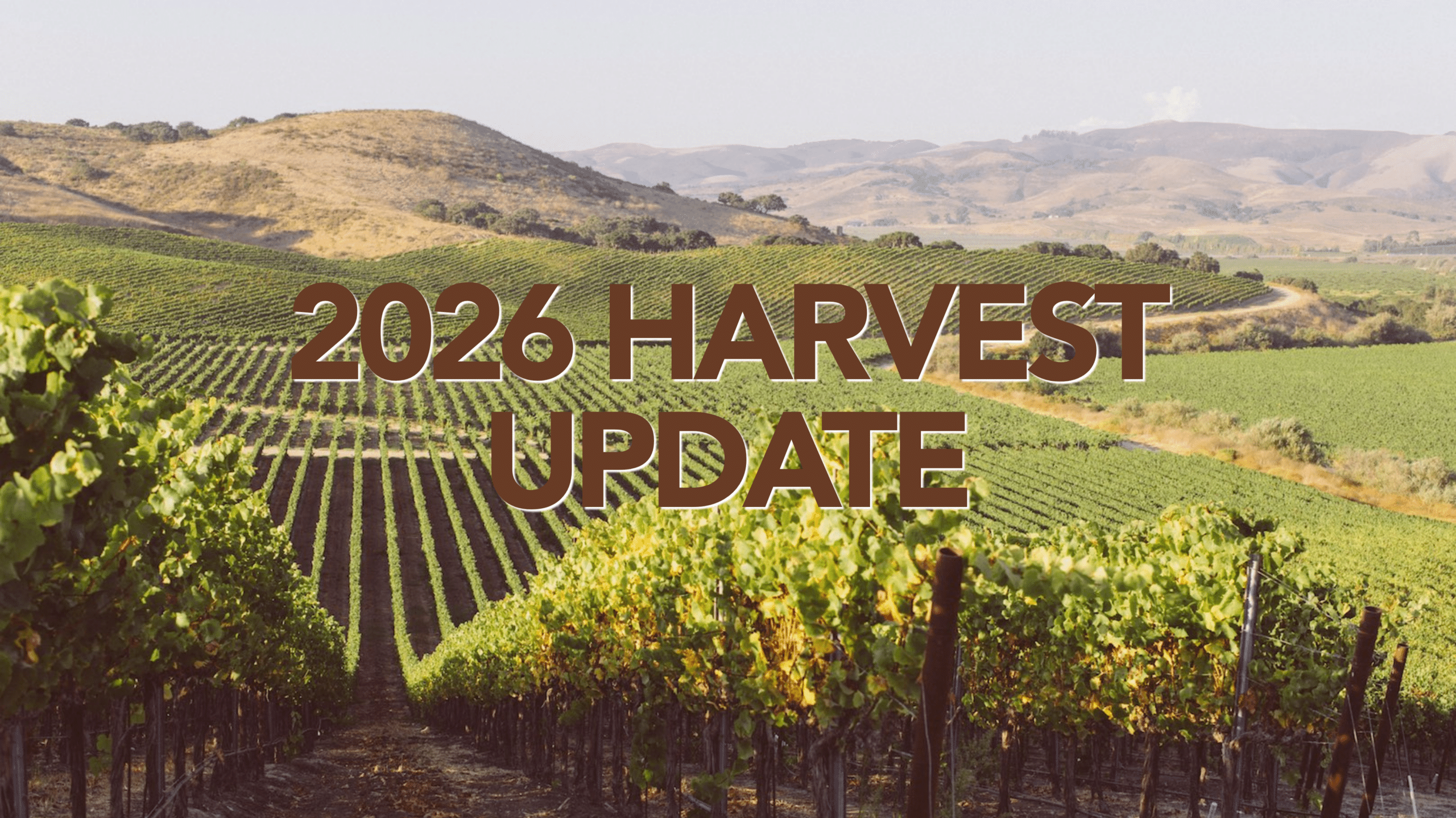
2026 Harvest Update: An Early, Unusual, and Exciting Vintage
A note before we dive in: there are still a lot of innings left in the game. We are at the end of May and harvest is months away. What we can tell you is that 2026 is already shaping up to be one of the most unusual growing seasons we have seen in years.
Growing Season
The 2026 vintage is running 4 to 6 weeks ahead of schedule in the Sta. Rita Hills, with inland sites like Ballard Canyon about 2 weeks ahead. A warm winter, warm spring, evenly spaced heat events, and adequate rain drove early bud break, early flowering, and early fruit set.
What that actually means: once bud break happens, it is essentially a shot clock until harvest. An early bud break means an early harvest, and right now the vineyards look closer to July than late May.
Yields
Expect roughly two-thirds of a normal crop. While crop yields depend on hundreds of factors, the leading theories are stress from a 2025 Labor Day heat wave carrying into this year, and a short dormancy period that pushed vines to spend energy on vegetative growth rather than fruit. No dramatic flowering events like shatter, it’s more about fewer clusters overall. Exception: Larner Vineyard in Ballard Canyon had windy conditions right at the end of flowering, so that site may come in even lighter.
Harvest Timing
Sparkling wine picks likely in July. Chardonnay and Pinot Noir could wrap by end of August, which would be unique. Some blocks may still finish around the normal window.
For context on just how unusual an August finish would be: in 2016, one of the earliest vintages in recent SAMsARA history, Mourvedre was picked on September 11th. That was the earliest that block had ever been harvested, a date that normally falls around Halloween or even into November. A vintage where Chardonnay and Pinot Noir are done before September would be genuinely unprecedented.
Vintage Comparison
2015 and 2016 are the closest parallels, light crops, warm seasons, powerful concentrated wines. The 2015s are considered some of SAMsARA’s best.
The reason lighter crops tend to produce more powerful wines is concentration. When a vine produces fewer clusters, the flavors, sugars, and compounds that make up the wine are distributed across less fruit. The result is wines that are richer and more intense. The 2015 SAMsARA wines are a strong example of this, and if 2026 follows a similar path, the resulting wines could be among the most compelling the winery has produced.
News
SAMsARA is making a Sauvignon Blanc for the first time in 2026, sourced from Happy Canyon.
This fits a pattern of SAMsARA experimenting with varieties and styles outside its Rhone-focused core, the same spirit that led to the Clairette and a few vintages of Rosé. Happy Canyon is one of Santa Barbara County’s most exciting appellations for white wines, and Sauvignon Blanc from that area has a devoted following. The vineyard source is still being finalized. More details to come.