No products in the cart.
Sideways Didn’t Just Change Pinot Noir & Merlot. It Changed Santa Barbara.
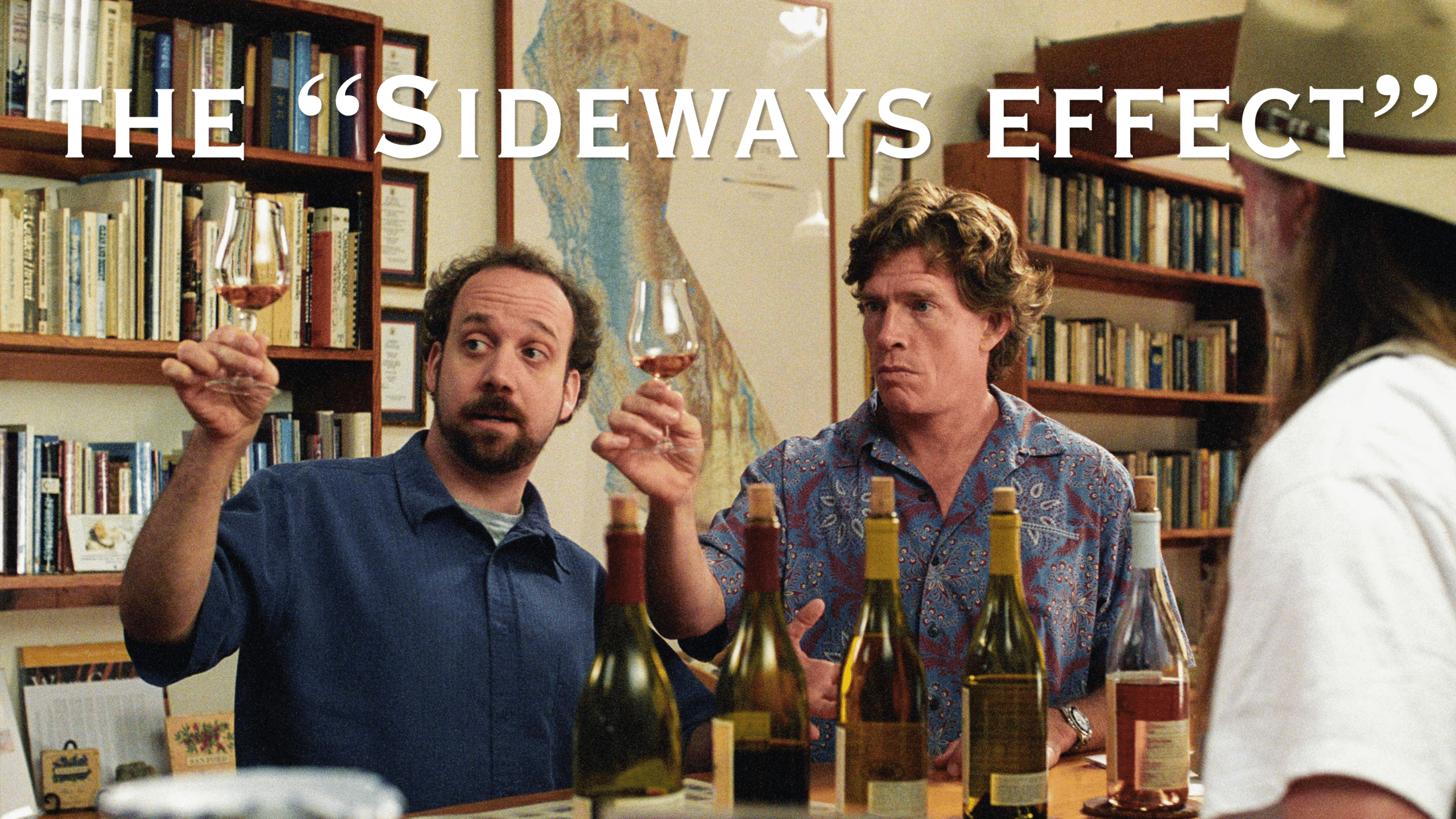
Sideways Didn’t Just Change Pinot Noir & Merlot. It Changed Santa Barbara.
Everyone knows the line. “I am not drinking any f*cking merlot!” One rant in a mid-budget road trip comedy, and suddenly Pinot Noir was the coolest grape in America.
People think of the Sideways Effect as the thing that made Pinot Noir famous and made merlot a joke. But the real, lasting Sideways Effect shows up in Santa Barbara County itself.
The Short-Term Numbers
Right after the film’s 2004 release, the wine world moved fast. Pinot Noir sales climbed 16 percent in the years that followed, and Santa Barbara growers leaned hard into the grape the movie had made famous. Merlot, meanwhile, took the opposite hit, sales dipped roughly 2 percent nationally over that same stretch, and the grape spent the next decade as a punchline.
What Really Happened
Santa Barbara had 2,774 acres of Pinot Noir planted in 2002. Plantings climbed steadily in the years after the film, and many in the industry believed the region had gotten a little too pinot-heavy for its own good. Around 2011, growers started realizing just how well certain pockets of the Sta. Rita Hills could do with Chardonnay instead. But the momentum hadn’t peaked yet, plantings kept climbing to a high of 5,751 acres in 2017 before finally coming back down. By 2023, the county sat at 2,913 acres, barely different from where it started two decades earlier.
Merlot’s slide had actually started before Sideways came out. Growers had over-planted the grape through the 1990s, flooding the market with cheap, forgettable bottles. The movie didn’t cause the decline, it landed in the middle of one already underway and gave people something to laugh at. And nationally, the grape’s reputation has been quietly recovering since, as producers plant it on better sites instead of leftover land and price it like the serious wine it can be. Napa’s 2024 crop report shows Merlot ranking third in total value among all varieties in the valley, and commanding a higher average price per ton than Chardonnay despite Chardonnay having more than 2,100 additional bearing acres. Two decades later, merlot is finally getting the positive attention it missed in the post Sideways era.
Zoom out further, and Pinot isn’t even the whole story in Santa Barbara anymore. The region has grown into roughly 80 different grape varieties, arguably making it one of the most diverse wine-growing areas anywhere in the world.
What Changed, and Stuck
Here’s where the story gets more interesting. While wine preferences shifted, dipped, and diversified, something else about the region transformed permanently: the towns of Santa Barbara County.
In 2001, the county had 60 wineries. Today there are more than 300. Los Olivos went from a sleepy, antique-shop kind of town to a place with 42 wine tasting rooms and a half dozen great eateries. The Santa Ynez Valley, home to just 20,000 residents, saw its daily population swell by as much as 20 percent in the year after the film came out, and it never fully went back down.
That surge built real, lasting infrastructure. New hotels have popped up across the valley, and an old Days Inn even reopened, fittingly, as the Sideways Inn. The valley now has six Michelin-recognized restaurants in towns that used to be considered a detour on the way to somewhere else. Average grape prices in the region have climbed noticeably over the past two decades, even as total acreage barely moved. That’s not just more vines. That’s the region’s reputation getting genuinely more valuable.
The Real Legacy
Ask people in the industry today what actually stuck, and grapes are rarely the first thing they mention. So maybe the fairest way to put it is this: the movie’s fingerprints on Pinot Noir and Merlot turned out to be temporary, two grapes that dipped, spiked, or dropped, then settled back close to where they started. But its fingerprints on the towns, the wineries, the restaurants, the entire identity of the region as a destination, never faded.
Two decades later, Santa Barbara isn’t known as the backdrop for a movie about wine anymore. It’s recognized as one of the most unique and diverse AVAs in the country, a place where nearly 80 grape varieties thrive across a patchwork of microclimates, standing on its own reputation rather than that of an awkward comedy.